

Figure M1
Full description
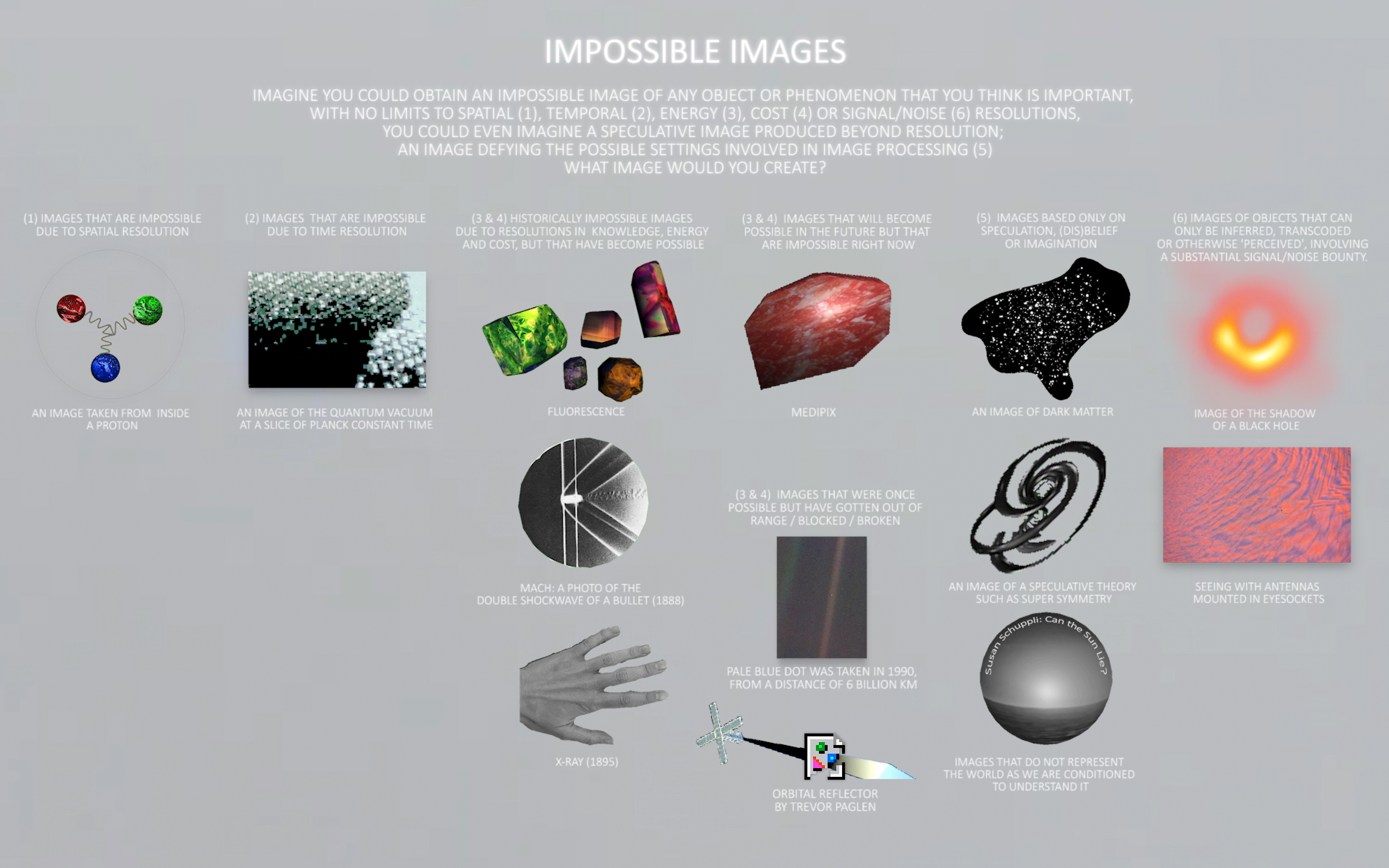
Title at the top: “impossible images”, followed by a description: “Imagine you could obtain an impossible image of any object or phenomenon that you think is important, with no limits to spatial (1), temporal (2), energy (3), cost (4) or signal/noise (6) resolutions, you could even imagine a speculative image produced beyond resolution; an image defying the possible settings involved in image processing (5). What image would you create? The text is followed by an image catalogue of historical and contemporary “impossible images” that includes 13 examples primarily from history of science to speculative and imaginary examples. Images from left to right columns (top row): First column, top of the image is the text (1) Images that are impossible due to spatial resolution. The image shows three “balls” (red, green, blue) connected by a wiggly thread. Below the image the text: “An image taken from inside a proton.” Next column, top text: (2) Images that are impossible due to time resolution. Below the text the image of a greyscale image that shades from black on the lower left corner to whiter on the top right corner. Below the image the text: “An image of the quantum vacuum at a slice of a Planck constant time.” Next column, top text: (3 & 4) “Historically impossible images due to resolutions in knowledge, energy and cost, but that have become possible. Below the text three images: different color polygon shapes with image text “fluorescence” below them. Under that image a microphotography image of a bullet penetrating what seems like a thin membrane, with image text: “Mach: A Photo of the Double Shockwave of a Bullet (1888)”. Below, an image of a human hand with image text “X-Ray (1895)”. Next column to the right: (3&4) Images that will become possible in the future but that are impossible right now. Top image below the text shows a red polygon shape with some whiter areas. Under the image the text “Medipix”. Below this an image with top of the image text: “(3&4 Images that were once possible but have gotten out of range/blocked/broken” that shows a rectangular image, mostly dark with a more pale strip running through it. Image text below it: “Pale Blue Dot was taken in 1990, from a distance of 6 billion km”. Bottom row below this contains an image that seems to consist of a satellite type left part and a rectangular shape in the middle with different colour shapes inside that shape and an arrow-like right part. Image text: “Orbital Reflector by Trevor Paglen”. Next column to the right: “(5) Images based only on speculation, (dis)belief or imagination”. Image below contains an odd shaped blob with multitude of white dots like a night sky. Image text below: “An image of dark matter”. Below it a whirl shape in black, image text below: “An image of a speculative theory such as super symmetry.” Bottom row shows a circular image with a sun-like dot in the centre and text inside the circular shape says “Susan Schuppli: Can the Sun Lie?”. Below the image the text: “Images that do not represent the world as we are conditioned to understand it.” Far right column, top of the column text: “(6) Images of objects that can only be inferred, transcoded, or otherwise ‘perceived’, involving a substantial signal/noise bounty.” Below this text a round bright shape with the text below it: “Image of the shadow of a black hole.” Below this image a rectangular shape that seems like a red, blue patterning of the type of clouds lit up with evening red glow or other similar sort of a mass of topographic type shapes with image text: “Seeing with antennas mounted in eyesockets.”
Comments
to view and add comments.
Annotations
No one has annotated a text with this resource yet.
- typeImage
- created on
- file formatjpg
- file size3 MB